
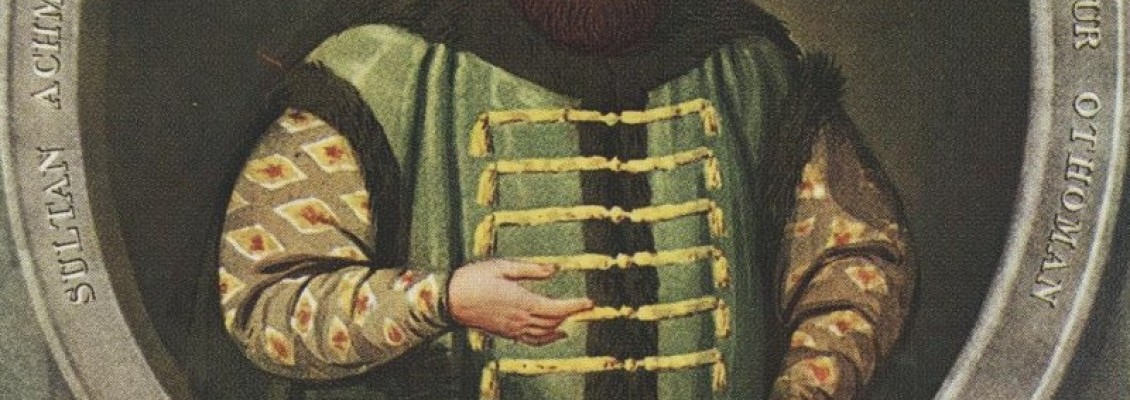
SULTAN AHMED I
Sultan Ahmed is a familiar name for both visitors of the Blue Mosque and locals. While the popular name “Blue Mosque” comes from the mosque’s stunning blue tiles, its original name in Turkish is “Sultan Ahmed Mosque.” The mosque was named after Sultan Ahmed I, who commissioned its construction. In this article, we will give a brief overview about Sultan Ahmed I and his reign.
His Life
Sultan Ahmed I was the 14th ruler of the Ottoman Empire. He was born on April 18, 1590, in Manisa, which was an important city for Ottoman princes. He was the son of Sultan Mehmed III and Handan Sultan. He became sultan in 1603 when he was only 13 years old, after the death of his father. Ahmed ruled until his death in 1617 at the age of 27, which makes his reign one of the shortest in Ottoman history. Even though he ruled for only 14 years, he left an important mark on Istanbul and Ottoman culture.
His Piety and Love for Islam
Sultan Ahmed I is remembered as a ruler with strong faith and humility. When the construction of the Blue Mosque started in 1609, he personally took part in the work. To show modesty and encourage the workers, the young sultan struck the first pickaxe into the ground and even carried soil in his robe.
The sultan’s respect for holy places extended beyond Istanbul. When mistakes were found in the designs of the kiswah—the cloth covering the Kaaba—, which was produced in Cairo, Ahmed ordered the kiswah and the curtains for the Prophet Muhammad’s tomb to be made in Istanbul instead and then delivered to Mecca and Medina. For this, he built a special workshop on the site where Beylerbeyi Mosque stands today. This workshop also produced special candles for the Sacred Mosque in Mecca.
In 1612, Ahmed I ordered the repair of the worn walls of the Kaaba and sent expert craftsmen from Istanbul for the work. He had a golden rain spout made for the Kaaba and installed an iron railing around the Zamzam Well for safety. He also sent two jewel-studded oil lamps to Mecca and Medina, along with a marble pulpit for the Prophet’s Mosque. In addition, he encouraged the tradition of lighting lamps in mosques during Mawlid, the night celebrating the Prophet Muhammad’s birth.
Sultan Ahmed showed his love for the Prophet in other ways too. He brought the Prophet Muhammad’s footprint (Qadam-i Sharif) from Cairo and placed it in the new mosque he built. Later, he dreamed that Sultan Qaitbay, whose tomb had housed the relic, complained about this before the Prophet, who told him to return it. Upon waking, Sultan Ahmed immediately sent it back and had a small replica of the footprint made, which he placed on his royal emblem along with a poem he wrote.
His Contributions to Architecture and the City Landscape
Sultan Ahmed I left a lasting mark on Istanbul and the Ottoman Empire. The most famous of these is the Sultan Ahmed Mosque, widely known as the Blue Mosque because of its beautiful blue tiles. Built between 1609 and 1616, this mosque became one of the greatest symbols of Ottoman architecture.
The mosque was unique because it combined traditional Ottoman and Byzantine elements, featuring six minarets, a large central dome, and a spacious courtyard. It was designed not only as a place of worship but also as a complex that included a madrasa (religious school), a hospice, and a market. This made it a center of both spiritual and social life in Istanbul.
Beyond the Blue Mosque, Sultan Ahmed I commissioned fountains, gardens, and public spaces to beautify the city. He supported the construction and restoration of mosques, schools, and charitable foundations throughout the empire.
Leave a Comment