WONDERS OF TÜRKİYE: GÖKMEDRESE
The lands of Türkiye have been home to countless civilizations throughout history, and each of its cities offers visitors unique cultural and historical treasures. In this article, let us travel back to thirteenth-century Sivas, one of the most important cities of the Seljuk Sultanate, and explore the magnificent Gök Medrese.
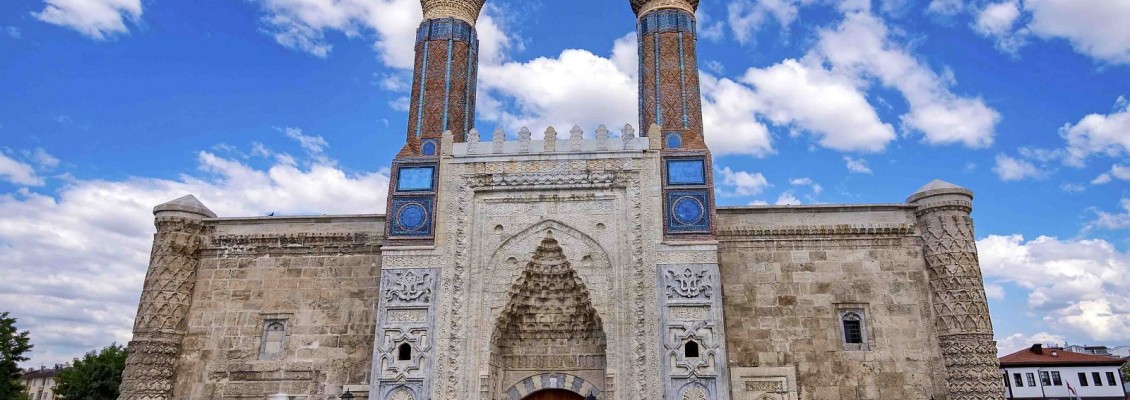
Located near the city center of Sivas, directly opposite the historic citadel, Gök Medrese is one of the finest examples of medieval Islamic architecture in Anatolia. The madrasa was commissioned in 1271 during the reign of Sultan Ghiyath al-Din Kaykhusraw III by his influential vizier, Fahreddin Ali ibn al-Husayn, better known as Sahib Ata.
Sahib Ata was one of the most prominent statesmen of the Seljuk period. Despite experiencing both political successes and setbacks throughout his career, he became famous for his charitable works and his patronage of art and architecture. Because of his generosity and numerous public endowments, people referred to him as Abu'l-Khayrat, meaning “The Father of Good Deeds.”
The name Gök Medrese, which literally means “Sky Madrasa” or “Blue Madrasa,” comes from the turquoise and sky-blue tiles that once decorated the building. Its other name, Sahibiye Madrasa, is derived from its founder, Sahib Ata.
Architecture
The madrasa is renowned for its monumental portal adorned with intricate geometric and floral carvings, as well as its twin minarets, which have become one of the symbols of Sivas. The elegant stonework and decorative motifs demonstrate the artistic sophistication achieved by Seljuk craftsmen in the thirteenth century.
One of the defining features of Seljuk art is its use of geometric decoration, and Gök Medrese offers some remarkable examples. The portal is adorned with interlacing stars, polygonal patterns, braided bands, interconnected geometric networks. These patterns have both artistic and symbolic significance. Because geometric designs can theoretically continue infinitely, they are often interpreted as symbols of the infinite nature of God and the eternal order of creation. Islamic artists intentionally avoided creating empty spaces. Every surface is carefully organized and decorated, reflecting the principle that divine order exists throughout the universe.
Alongside geometry, the madrasa is richly decorated with vegetal motifs, known in Islamic art as arabesques. Visitors can observe tree of life, stylized palmettes, rumi motifs, lotus-like forms, curving vine scrolls, leaf patterns. These motifs symbolize life, growth, and paradise. In Islamic thought, gardens represent the beauty of Paradise described in the Qur'an. The famous Rumi motif, widely used in Seljuk art, consists of highly stylized, curved leaves and split-palmette forms that create elegant flowing compositions. These motifs became one of the visual signatures of Seljuk artistic identity.
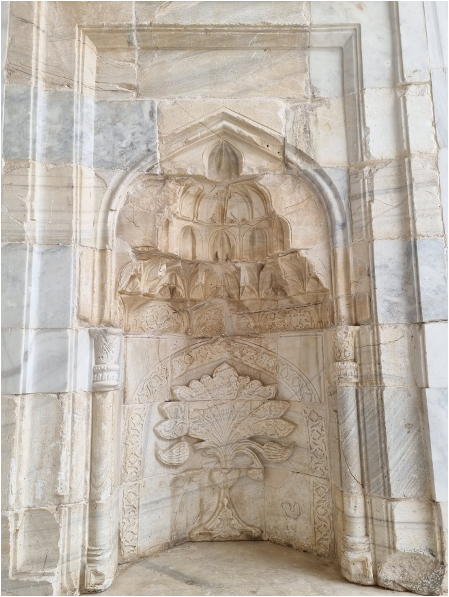
Above the entrance, visitors can admire one of the most sophisticated elements of Islamic architecture: the muqarnas. Often called “stalactite decoration” or “honeycomb vaulting,” muqarnas consist of small niche-like elements arranged in tiers. They create a fascinating transition between architectural surfaces and produce an extraordinary play of light and shadow.
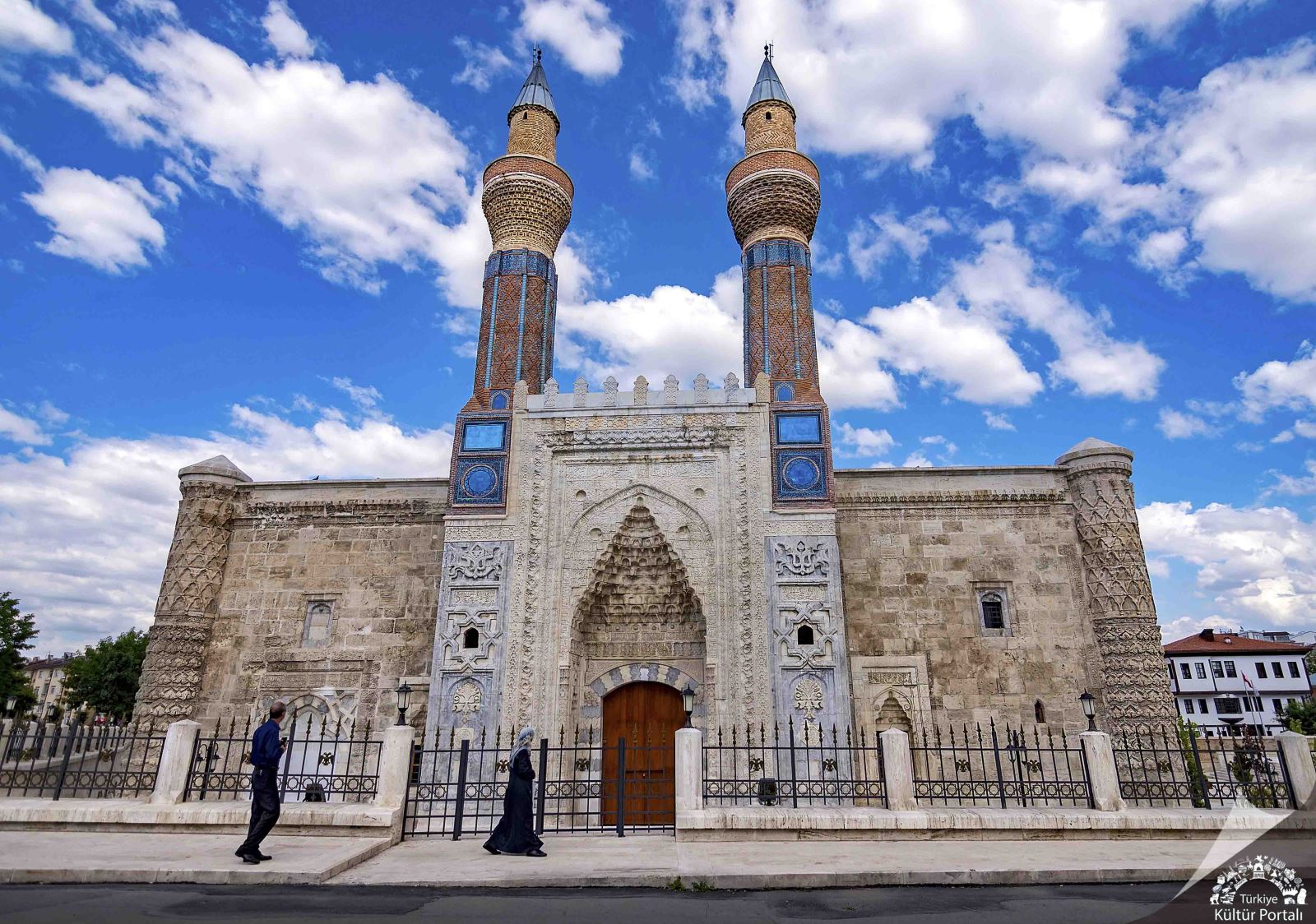
One of the most distinctive features of Gök Medrese is its emphasis on symmetry. The building was carefully designed so that its spaces are arranged around a central axis. The building materials also deserve attention. The architects combined cut stone, marble, brick, and glazed tiles, creating a rich contrast of textures and colors. The massive stone walls not only provided structural strength but also protected the students from the harsh climate of central Anatolia, keeping the rooms cool in summer and relatively warm in winter.
The famous twin minarets rising above the entrance had both practical and symbolic functions. They announced the importance of the institution from afar and transformed the madrasa into one of the most recognizable landmarks of medieval Sivas. Their verticality also draws the eye upward, giving the entire structure a sense of grandeur.
Madrasa
Like many Seljuk madrasas in Anatolia, Gök Medrese was built around an open central courtyard. Once visitors passed through the monumental entrance, they entered a spacious courtyard that formed the heart of the complex. This open area was much more than a simple passageway: it functioned as a place where students gathered, discussed lessons, and spent their daily lives.
Surrounding the courtyard were student cells (hujras), small rooms where students lived and studied. These chambers created an academic community similar to the residential colleges of modern universities. Students could attend lectures, spend time in study and worship, and remain in close contact with their teachers.
The madrasa also contained iwans, large, vaulted halls that opened onto the courtyard. These spaces served as classrooms and meeting areas where scholars taught subjects such as Qur'anic exegesis, Islamic law, theology, and Arabic language. The arrangement of the iwans and rooms around the courtyard created a balanced and harmonious environment that encouraged both learning and contemplation.
What makes Gök Medrese particularly fascinating is that it was designed not simply as a school but as a living academic institution. It combined classrooms, residential quarters, courtyards, and places for intellectual discussion within a single architectural complex. In many ways, it functioned as one of the great universities of the medieval Islamic world.
Walking through Gök Medrese today, visitors can still imagine the daily life of the thirteenth century: students crossing the courtyard with their books, scholars teaching beneath the vaulted iwans, and lively discussions taking place within these stone walls. The architecture itself tells the story of a civilization that regarded knowledge, education, and learning as among its highest values.
Leave a Comment